Your organization’s judgment on legislation is the hardest thing to teach and the easiest thing to lose, and it doesn’t scale the way bill volume does. Five reviewers manually triaging the same tracker means five slightly different standards for “high priority”. A new hire’s first month looks nothing like your senior analyst’s. And when that analyst leaves, the standard leaves with them; whatever the next person inherits is a tracker full of tags with no record of the thinking behind them.
The Bill Tracker Agent, now available for Quorum State and Federal, applies your organization’s standard to every bill, whether it’s reviewer one or reviewer twelve doing the triage. That standard lives in the issues your team already manages in Quorum, so it is there for every reviewer on every bill.
A Fully Agentic Experience, From Bill Discovery to Decision
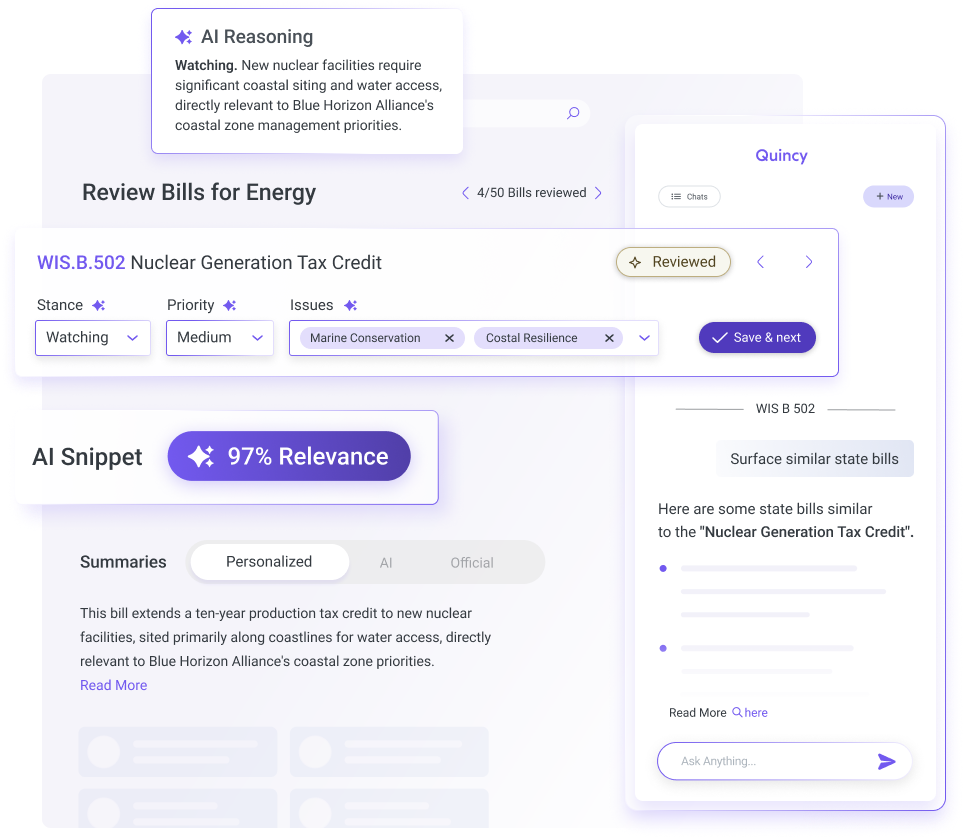
The Bill Tracker Agent automates policy triage and risk analysis end-to-end, grounded in the issues your organization already tracks. It reviews every bill and matches it to the issue it belongs to. Then it suggests a stance and priority, writes a summary from that issue’s own context, and lays out the reasoning in plain language. No positions are applied until your team confirms them, and each issue’s knowledge grows with every review.
Put together, that’s the whole point: Bill Tracker Agent isn’t a search tool with an AI feature bolted on. It’s one continuous, agentic system: discovery, relevance, and decision, all grounded in the issues your organization has already defined, not a surface-level keyword match.
What Changes at the Organizational Level
Ground Every Position in Your Own Playbook
This is the piece that matters most for how your team actually operates. Your issues are the playbook. Each issue your organization tracks in Quorum, whether healthcare, energy, or tax, carries its own context: the URL, PDF, and notes your team has added, plus what the Agent has learned from your team’s reviews.
When a bill arrives, the Agent first matches it to the issue it belongs to. Then it reasons from that issue’s context to suggest a stance and priority and write the summary. A healthcare bill gets healthcare context. An energy bill gets energy context. Stance, priority, and summary reflect real depth on that issue, the way you would trust a subject-matter expert’s read on a healthcare bill over a generalist’s.
Here’s what that means in practice: with every position your team takes, the Agent builds institutional knowledge in the issue itself and creates a standard that new and experienced teammates can follow alike. A reviewer in their first week works from the same playbook as your longest-tenured analyst. When someone leaves, the standard they built doesn’t leave with them; it’s already the the issue’s baseline for the next person. Nothing about it is a black box. Your team can see exactly what the Agent has learned in each issue, correct it, and add to it. You also choose which issues count, so the Agent reasons only over the areas you want it working in. The Agent works only from your organization’s information, as an extension of your team, not an outside analyst guessing at your priorities.
That’s the payoff of institutional knowledge that compounds: every review adds to a standard the whole team can draw on, so your organization’s judgment gets more complete over time.
Set Up Context Once, Where You Already Work
The issues you track already define what your organization cares about. The Agent reads from that same setup, so there is no second configuration to build and keep current. Add a URL, a PDF, and your own notes to an issue, and the Agent has what it needs. Tracking a new issue area? Set it up the way you always do, and the Agent starts reasoning from it. New teams answer “what do we care about” once, not twice.
Review Bills with More Precision
The daily payoff of that standard is straightforward: your reviewers stop spending their judgment on bills that don’t need it. The Agent matches each bill to your issues, recognizes when a bill affects your priorities and curates a must-watch list, and every bill already has a position suggested by the time your team opens it. That means your team’s attention goes to the close calls, not the hundreds of straightforward bills that don’t need a debate.
Act on Every State Bill with Confidence
None of this works without a clear governance answer, and it’s a simple one: nothing is ever applied without your team’s explicit confirmation. Furthermore, reviewed and unreviewed bills, relevance scores, personalized summaries, and reasoning all live on one screen, so your team reviews, assigns, and briefs without losing time or focus. The record reflects only what your team actually approved, so speed here never comes at the cost of control.
What This Looks Like on Your Team
Picture a Tuesday in March, mid-session, 60 new bills waiting across the states you cover.
Fifty-two of them already have a suggested stance, priority, and summary by the time your team opens the tracker, each matched to the right issue, with the reasoning attached. Anything that matches your organization’s standard is reviewed in seconds, leaving the day for the bills that actually need a debate. The tax bill that falls outside anyone’s specific expertise still gets flagged as a medium priority, with enough context attached so whoever reviews it isn’t starting cold.
And when one reviewer disagrees with a suggestion — say, the Agent tagged a bill support, and your organization actually opposes it — they update the position and move on. That update becomes part of what the issue has learned. The next similar bill, reviewed by anyone on the team, reflects it. That’s the difference between a tracker that resets with every personnel change and one that compounds: institutional knowledge stops living in one person’s head and starts living in the issues your whole team works from. Multiply that day by every reviewer, every state, and every session, and a different question starts to matter more than speed.
Why Consistency Is the Real Test
The real question was never how fast a bill gets tagged. It was always whether your organization’s positions hold together across every reviewer, every state, and every session, regardless of who’s on the team this year versus next.
That’s what a fully agentic bill tracking experience, from discovery through decision, is built to answer. It’s not a database your team visits to screen bills. It’s your system of record for the expert calls your organization makes on every piece of legislation, positions that compound instead of resetting every time your team changes.
Ready to Protect What Your Team Already Knows?
The Bill Tracker Agent is included at no additional cost for Quorum State and Federal customers. Quorum State helps government affairs teams engage officials, triage state bills, and report on their work, while Quorum Federal helps them build relationships, find champions, and strengthen their policy reputation across Congress, the White House, and agencies. The Agent grounds every bill in the issues your team already manages in Quorum, so there is nothing separate to build before it starts working.
Stop letting your standard live in one analyst’s head. Start building one that your whole team, and every future hire, can work from. Curious what else Quorum’s agents can do? Visit our AI Agents page.
Frequently Asked Questions
What is an AI Agent in government affairs?
An AI Agent is an autonomous system that performs specific workflows without requiring manual triggers from the user. The Bill Tracker Agent is a purpose-built example: it reviews every bill in your tracker automatically, suggests a Stance, Priority, and Issue for each one, and shows the reasoning behind every suggestion in plain language before your team has had to open a single bill. Your team’s only job is to review and confirm.
What does the Bill Tracker Agent provide?
Automated bill review and risk analysis, grounded in the issues your organization tracks. The Bill Tracker Agent scans every bill in your tracker, ranks it by relevance, and matches it to the issue it belongs to. Then it suggests a Stance and Priority and writes a Summary from that issue’s context. Every suggestion comes with a plain-language reason explaining the recommendation, so your team can confirm in seconds instead of researching from scratch.
How does the Bill Tracker Agent gather its data?
You stay in control. The Agent proposes a position, but nothing is applied to a bill until your team confirms it. If a suggestion doesn’t match your organization’s actual position, your reviewer simply changes it before confirming. That feedback is added to what the issue has learned, so the Agent’s future suggestions on similar bills reflect your organization’s actual judgment, not its original guess. The Agent’s job is to give your team a starting point; your team’s job is to decide the final position.
What happens if the Agent suggests a Stance or Priority we disagree with?
You stay in control. The Agent proposes a position, but nothing is applied to a bill until your team confirms it. If a suggestion doesn’t match your organization’s actual position, your reviewer simply changes it before confirming. That correction is remembered, so the Agent’s future suggestions on similar bills reflect your organization’s actual judgment, not its original guess. The Agent’s job is to give your team a starting point; your team’s job is to decide the final position.
Does the Agent apply tags to bills on its own?
No. The Bill Tracker Agent generates a suggested position and your team always reviews and confirms before anything saves to the record. The Agent handles the research, reasoning, and pre-fill in the background, but the final decision on every bill is always made by a person. Your organization defines its issues and the context behind them. The Agent does not set your priorities on its own.
How does Issue Management make the Agent smarter?
Issue Management is where your organization organizes the policy areas it tracks, and it is also what the Bill Tracker Agent reasons from. The Agent matches each bill to the issue it belongs to, then uses that issue’s context to suggest a stance and priority and write the summary. As your team reviews bills and gives feedback inside an issue, the Agent’s learned information for that issue grows. Your team can see it, edit it, and decide which issues the Agent uses.